
I’ve made a number of calls in the last couple of weeks regarding goats, visited three different goat owners, and after much thought and discussion narrowed my options down to the following:
a) Buy a milk goat from the goat broker (yes, that’s a thing!). He has only one, and I’ve been waiting a few weeks for him to get more milk goats, which he keeps saying he’s going to do soon. He mentioned in a later conversation that he also had several young female kids. This is the most expensive option (2000 shekels for the milk goat, and the kid is double the price I’ve seen anyone else asking for a non-purebred kid) but also the most convenient, as he will deliver. Not purebred. 3400 shekels.
b) Buy two purebred goats with high milk production that would double the output of the single milk goat above. However, there is the extra fee for delivery with someone who is licensed to do animal transport, and they are two hours away. 3500 shekels, seller flexible on price.
c) Buy a different nursing goat and her kid, but this seller was letting the kid have all the milk and there was no clarity about what quantity of milk we could expect. Basically the same pair arrangement as the first option but much less expensive, and a motivated seller. Need to arrange animal transport, also two hours away. Not purebred. 2400 shekels.
All goats aren’t created equal. They produce different quantities and flavors of milk, have different personalities, and have different physical features.
Physical features have no significance in and of themselves, but there are a couple of features that I prefer. I like the look of ears that flop to the side versus standing straight up, and I prefer no horns (though most goats have horns). They just look more friendly to me. That doesn’t mean they are more friendly, just that they give that impression to me!
I’ve been mentally going in circles thinking about all the different possibilities. The biggest question would seem to be which goats will give the most milk, since that’s what they’re being purchased for and the more milk they give, the faster the return on expenses is. They basically eat the same amount regardless of the amount of milk they give, so it makes sense to get the highest milk production goats I can find.
Again and again, I circled back to the purebred option as the best value. Not only would I get double the milk quantity, opening up possibilities of yogurt and cheese making for our family diet, the future kids of a purebred animal will bring a higher price. Physically, this pair of goats have long horns sticking straight up on top of their heads. My boys told me that’s a good thing, that it makes them easier to hold onto and direct. I don’t love the look, but how important are looks when you’re buying milk goats?
The third goats I decided to completely take out of the equation – though I liked the way they looked, they were far away, so going to see them would be a five hour trip. And then if I wanted them, there would be the extra expenses. None of which seemed justifiable for a questionable amount of milk.
Back and forth, back and forth I circled. I strongly preferred the first set of goats but it didn’t seem smart financially. For three days I couldn’t make a final decision, and I was getting fed up with my indecision.
The frugal me was really resisting on this front; I really hated the idea of being a motivated buyer and paying more for them than any other goats I had seen listed. But the way they looked really mattered to me – if something is going to be in my space, I’d like to have a positive feeling when I look at it, rather than tolerating it. Finally, I realized that I just needed to allow myself to spend more money and be grateful that I found a good milking goat with the features I wanted, and not need to get a bargain deal on top of that. Sometimes the price really isn’t the most important criteria.
**Edited to add: after writing this, I had another conversation with the seller, and he explained something that I hadn’t previously understood. He told me that he bought these goats as kids from a small farm that has bred them for high milk production. I only knew they weren’t purebred. Until this conversation I thought the reason he could charge such a high price was because he was a good salesman. If I had understood that they are objectively very desirable milk goats, I wouldn’t have had any hesitations about the price in my decision making process! As I’ve told my children about other things, if you listen to your gut feeling you’ll never regret it, even if you don’t know why you’re making the choice you do, and that’s certainly the case here. ***
And so, introducing pair A, Buttercup and Bambi!

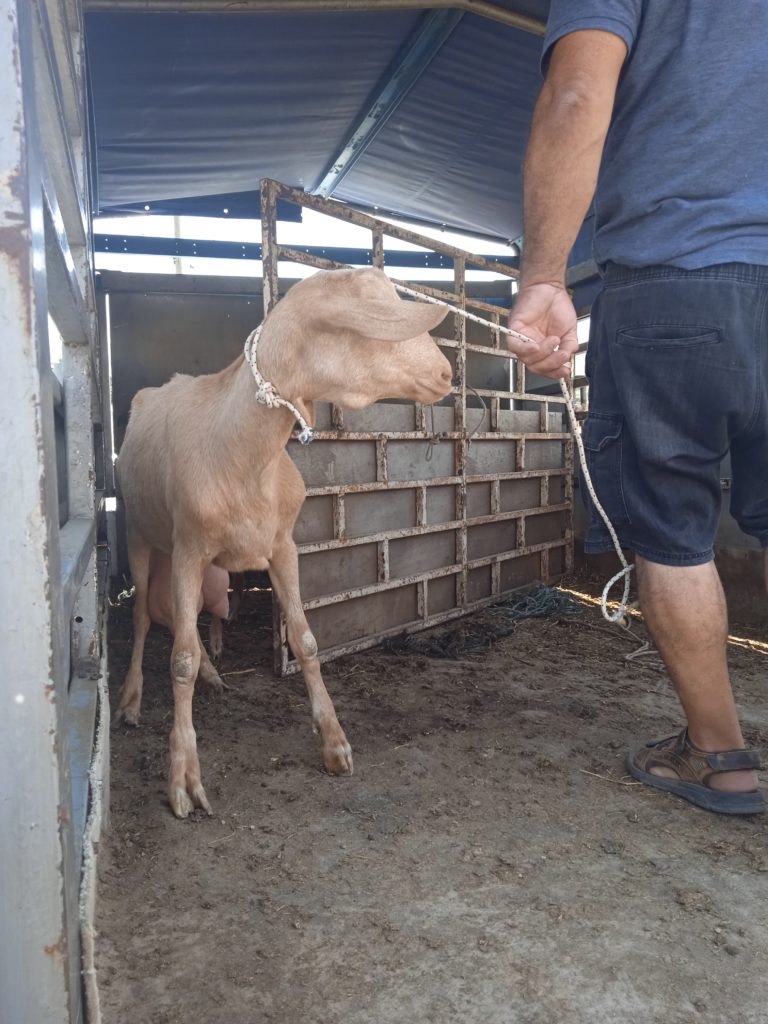
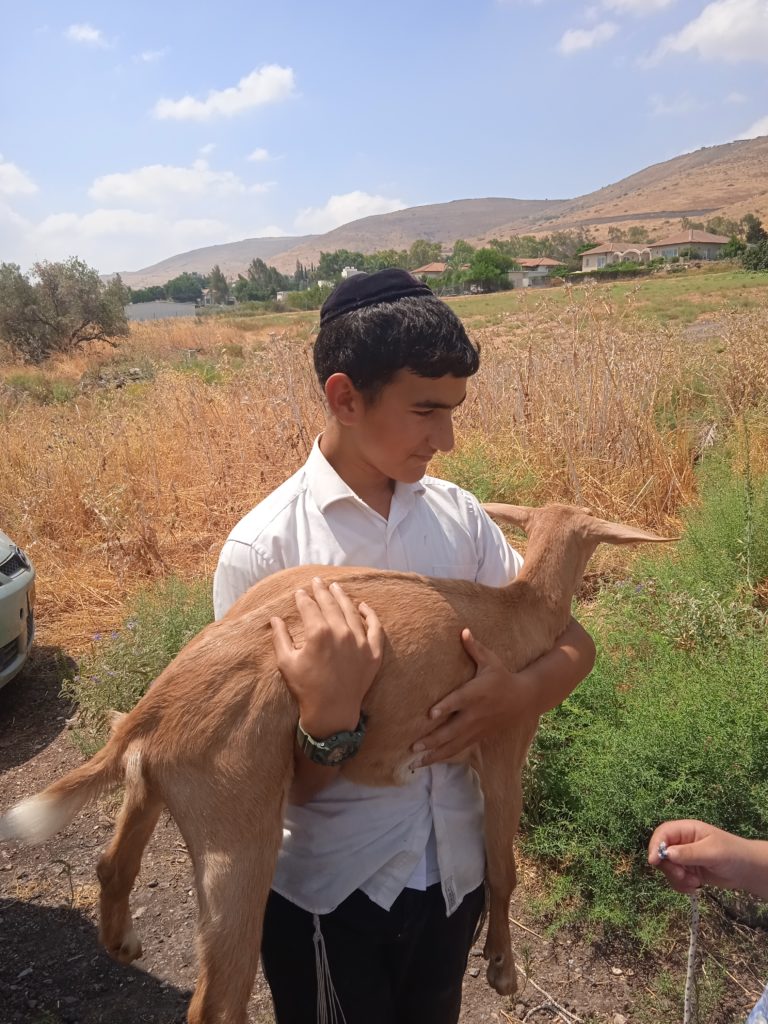
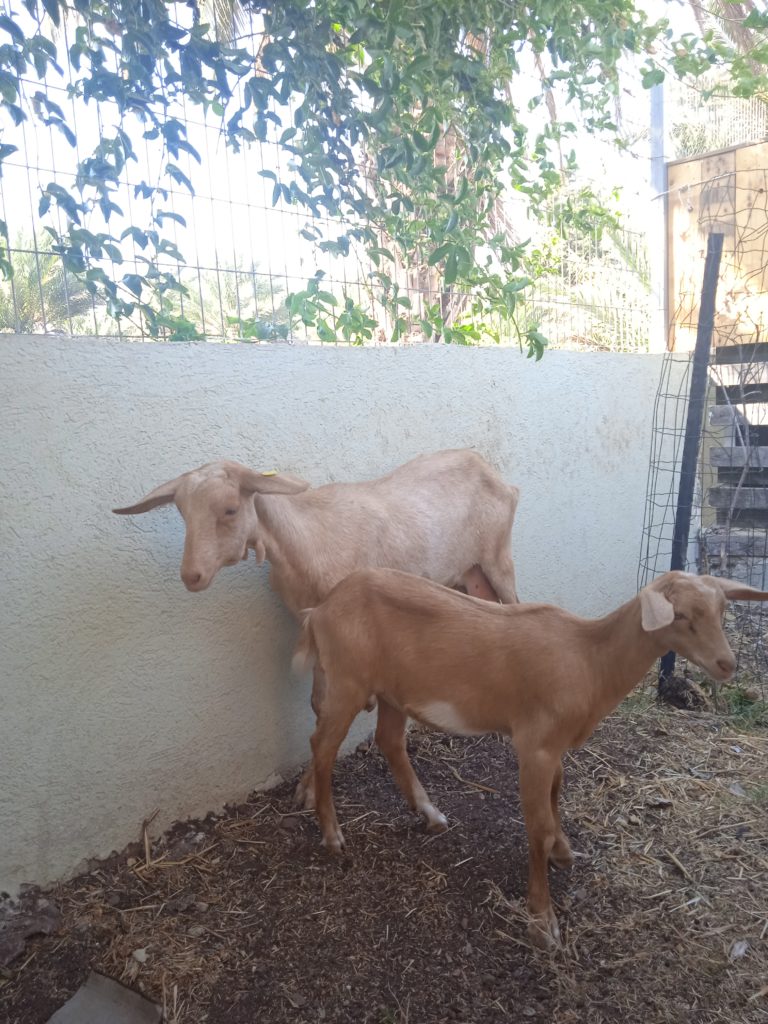
We had two young fruit trees growing in the area where we built the pen. Since goats like to browse (climb up and eat from trees and bushes), we surrounded each with a metal post and fencing to protect them. Despite our protective efforts, they were persistent about getting to it and within a few hours, the persimmon tree had no leaves left – that’s the stick you see next to the post above. I hope it will continue growing but accept it may not. So far the fig tree is holding its own – they don’t seem to like the flavor.
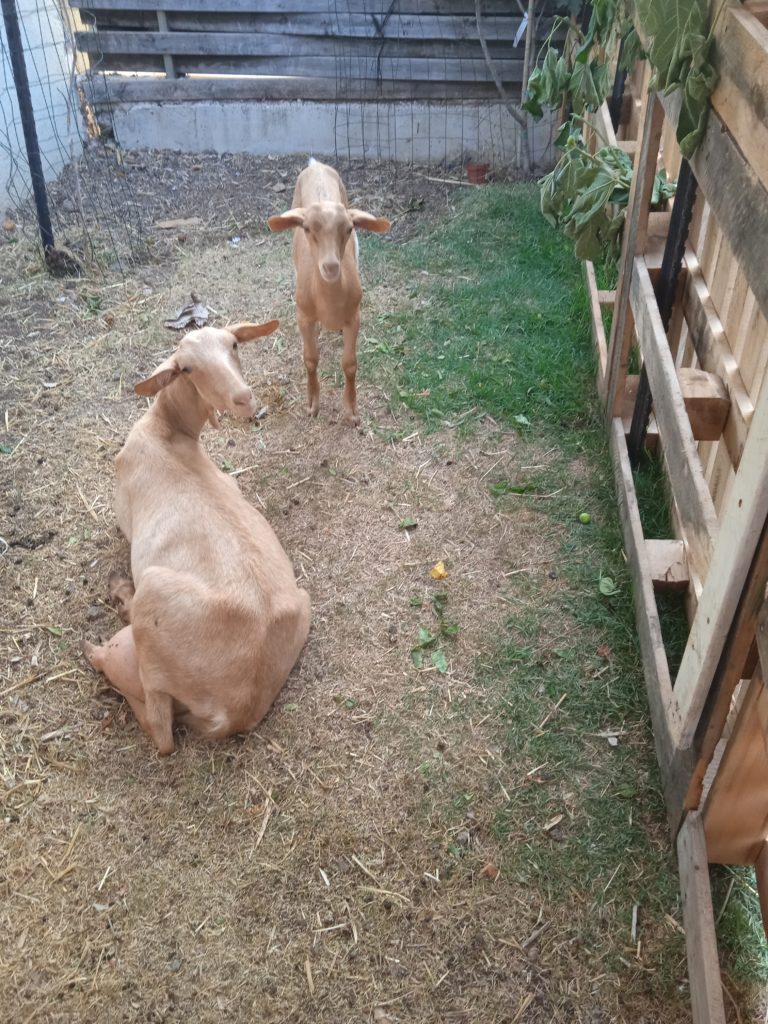
They are very sweet and though a little skittish, after just a day they’ve gotten much more comfortable with us.
We’ve had two milkings so far, and have been very appreciative of how patient and calm Buttercup is while being milked. Her milk is rich and delicious, and we’re all happy with the newest inhabitants of our yard and to have our own source of raw milk!
Avivah
12 Responses
I couldn’t find information on the internet if Grazon is used in Israel, but a lot of gardeners around the world are having their gardens contaminated by straw/hay from fields sprayed with grazing (the half life is 2+ years). Plus animals fed the straw/Jay pass it on to their manure. You also need to ensure any compost you buy is free of grazon. Non grass like alfalfa is ok since grazon would kill it. The best way to test for grazon is to plant beans into a pot that contains the item you are checking for contamination. Beans are recommended because they show the physical signs of contamination faster & cheaper than other plants like tomatoes, etc. There are currently no lab tests for Grazon.
Thank you for bringing this up, Bets! It’s a really important topic.
I’ve heard about the issues people are having with their gardens being contaminated by using composted animal waste from animals fed hay that was sprayed with Grazon prior to harvest. It’s terrible. It’s not just a theoretical issue for us since I want to use the composted waste by-products from our goats for our garden once shmita is over.
I didn’t know about alfalfa, that’s really helpful and reassuring information. Our goats have been eating alfalfa hay from the person I bought them from, and I just ordered two bales of clover that will hopefully arrive by tomorrow morning. It looks like clover is similar to alfalfa in that Grazon will kill it, so we should be safe with this. I had been worried about the Grazon issue (of course I’m sure it’s sprayed with other stuff), so thank you so much for giving me peace of mind on this!
I’m so glad this information was helpful. And thank you for the information that Grazon is used in Israel. I will be making Aloiya (of all goes well) and I already own my apartment which had a garden. I want to put in raised beds and the current soil is not so good so I will need to do a lot of composting to amend the soil and use in the raised beds. Now I know not to use most/all hay/straw and high-level manure (plus test it prior to using it in my beds. I guess it will be harder to build the beds than I originally thought and will have to take it more slowly.
I’m sorry, I should have been more clear, Bets. (And I apologize for the delayed response; for some reason I’m no longer getting notifications about blog comments in my email inbox.)
I don’t know for sure if Grazon is being used in Israel or not – I’ve heard about the issues gardeners are having in the US with the contamination. I had been concerned about it being a possibility and didn’t know how to check but thanks to your post I now am reassured that I can use clover and alfalfa hay for my goats, and use the old hay for my raised beds (that aren’t yet built but that’s another project that is soon to begin!).
Some people get large quantities of organic material from the KKL forests, that sometimes have big piles that are for the taking. Those wouldn’t have any issues of contamination. I haven’t yet gone that route since I’m not ready for it – I’m now gathering pallets for the raised beds – but it’s another option.
Good luck with your aliyah, I hope it goes smoothly. And how wonderful that you already own an apartment with a garden!
How exciting, may they be a positive addition in every way!
My girls and I are going to a nearby city for a couple of days early next week and if we make it to your area, would love to stop by to say hi to you and see the goats!
Please do stop by, Rivka! And you can say hello to your friend who is now my new neighbor while you’re here. 🙂
So glad I was able to stop by – always great to see you. And the goats are sweet and adorable – it’s so cute how they match your dog!
It was so nice to see you and I’m glad you popped over to visit!
My daughter was commenting how it’s funny how my dog and goats (and rabbits) all have very calm and gentle natures, but that’s not a coincidence – that’s what I value!
Avivah , Mazel Tov on your new additions! I am sure everyone will enjoy taking care of them. Are you by any chance able to let them on the land in back of your home? ( The picture of where your DS is holding one of them also to graze there?) I hope it all works out. Their names are so cute. Deep down I am an animal lover but because I have lived for Many years in apt. bldgs. the soft side of me is covered up a bit. may they bring you alot of healthy milk and enjoy!!
Thanks, Rachelli!
I had planned to graze them in the open area near my home, but the seller recommended that I not do that. Since they aren’t used to it, he said it will stress them and it would be better to keep the in their pen, and dried up weeds wouldn’t be appealing for them since they aren’t used to grazing. I’m planning to graze the when the weather is cooler and there is fresh green growth, though.
So cute! I’m glad you went with the right choice for you.
Thanks, Anna! It’s like this in all areas of life – what’s right for one person is the wrong choice for someone else in the same situation.