
We all know that with inflation, food prices have gone up and it’s impossible to stay in a budget.
I want to reassure you that you can still keep to a budget using smart shopping strategies. Last week I emerged from Shufersal, not a cheap supermarket, with this big cart of groceries for 400 shekels. I did that by stacking my savings strategies, and today I’ll talk about one of them.
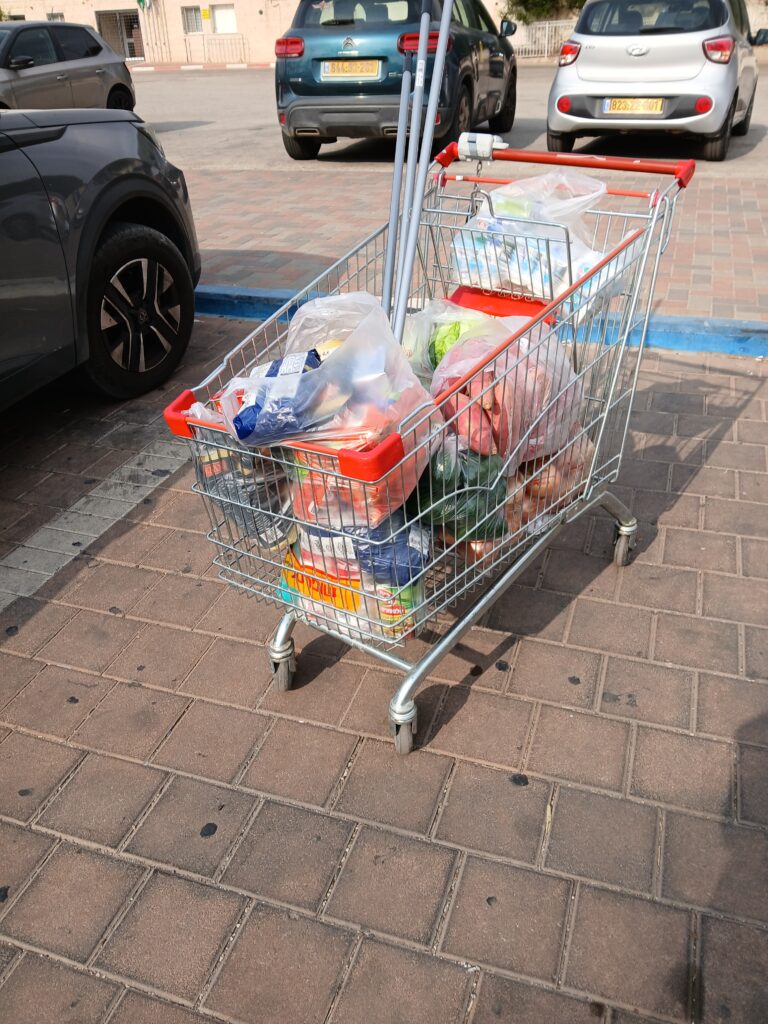
One thing you need to pay attention to when grocery shopping are the prices per unit – not the total price. If something isn’t on sale, this is easy – the unit pricing will be on the price tag above or below the the item.
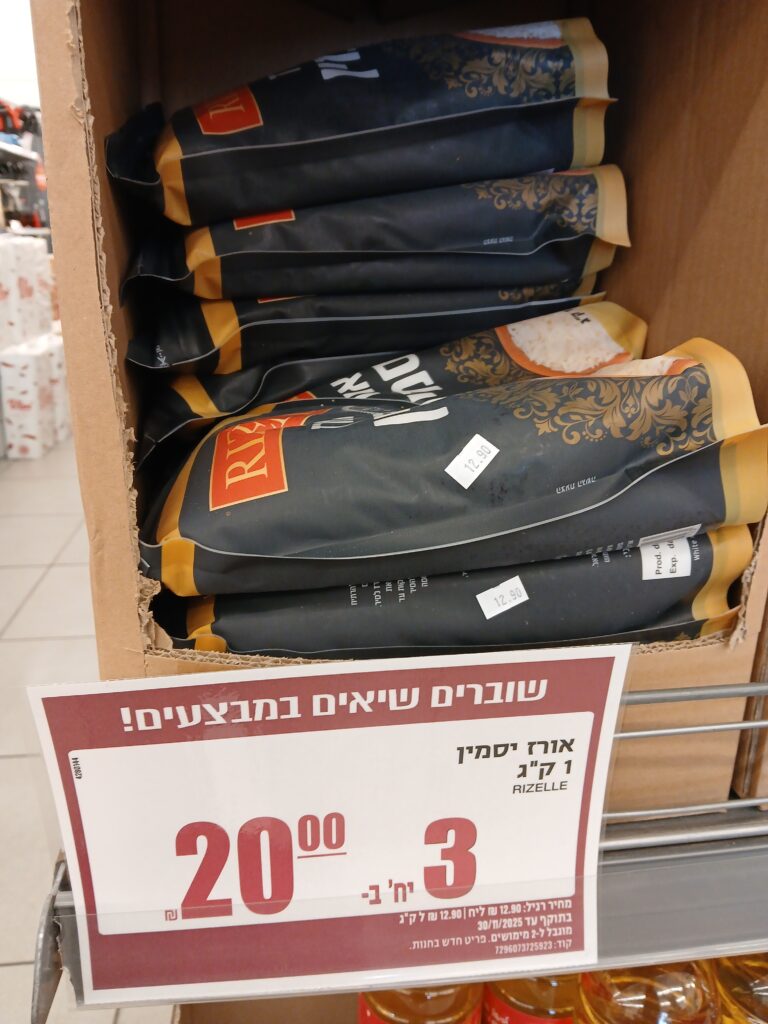
Looking at the smaller print in the red section below the highlighted price in the picture above, we can see the regular unit price is 12.90 a kg. However, the unit sales price is never listed, so anytime you’re buying a sale item, you’ll need to figure the unit price yourself. In this case, 20 shekels divided by 3 is 6.66 a kilo. So this jasmine rice is almost fifty percent off the regular price, and if you like jasmine rice, it’s the time to stock up.
However, there’s another rice also on sale: Thailand rice. The usual price is 7.90, and the sale price is 2 kilos for 12 shekels, so 6 shekels a kilo.
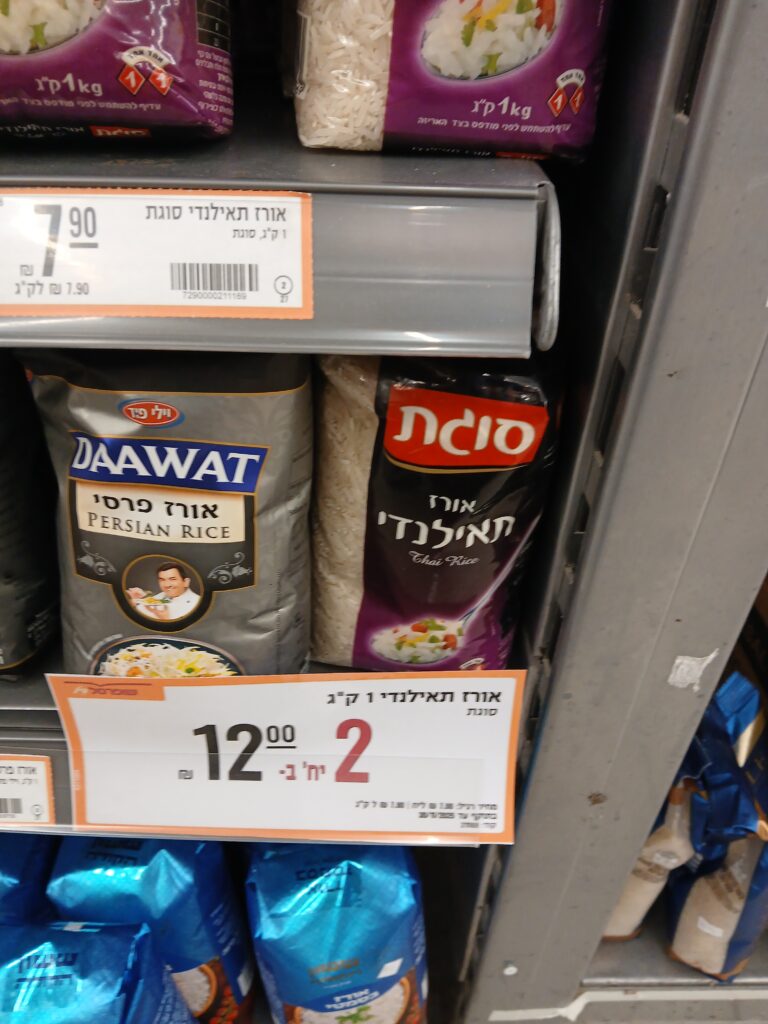
The two options are now very similar in price: jasmine rice for 6.66 kg, or Thailand rice for 6 shekels a kg. What do you buy?
In my case, I bought the jasmine rice, even though it was a little more expensive, because that’s what I preferred. But if the price difference was more significant, I would have gotten the less expensive one since I’m not enough of a rice connoisseur to spend much more on it.
The unit pricing for the rice was easy to figure out. Sometimes you have to do a drop more figuring to know what’s the better price, since the packaging sizes aren’t consistent and it makes it more confusing for shoppers. To figure out what gives you the most value for your money, it’s worth pulling out a calculator if you’re not comfortable with mental computing.
Below are the two different sizes of tomato paste on sale. There’s a tendency to assume that the larger packaging will always be less expensive, and often that’s true. But not always. So don’t assume.
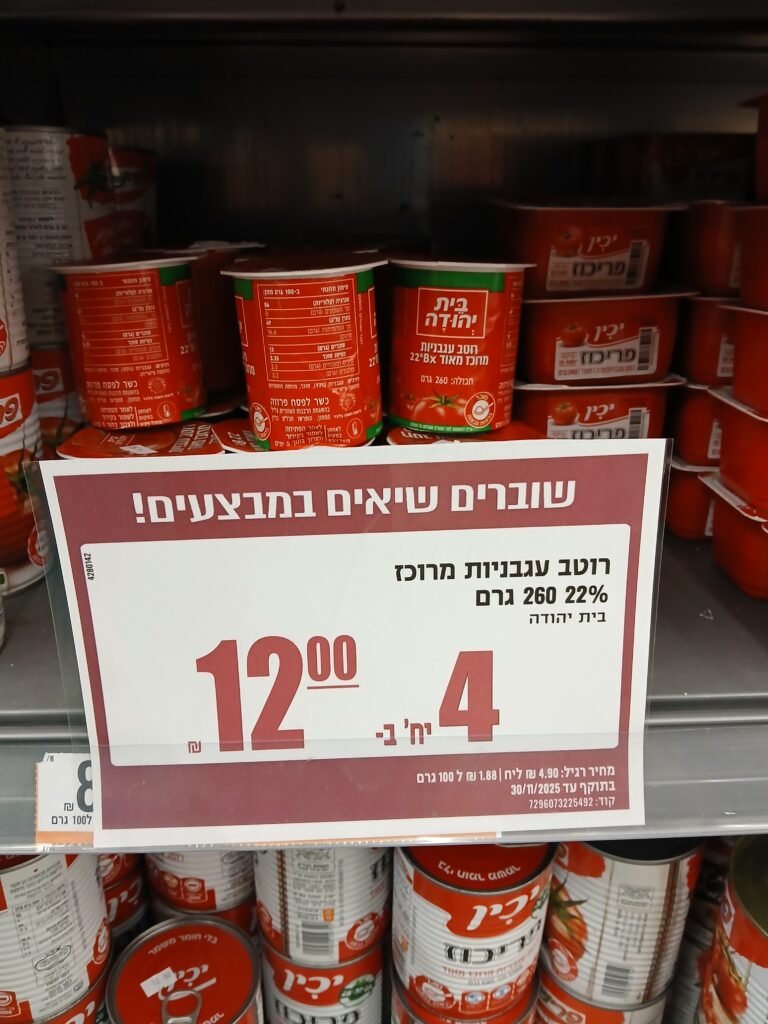
Above is a 260 gram package of tomato paste; it’s usual price is 4.90 each/1.88 per 100 grams (again, listed on the first line in the dark red below). So right away you can see that for 3 shekels a container, that’s a nice savings from the usual 4.90 price.
Since I noticed that in the front of the store – located completely separately from these so it took more effort to price compare – there was tomato paste in 100 grams also on sale, I took the time to figure out the pricing for that.
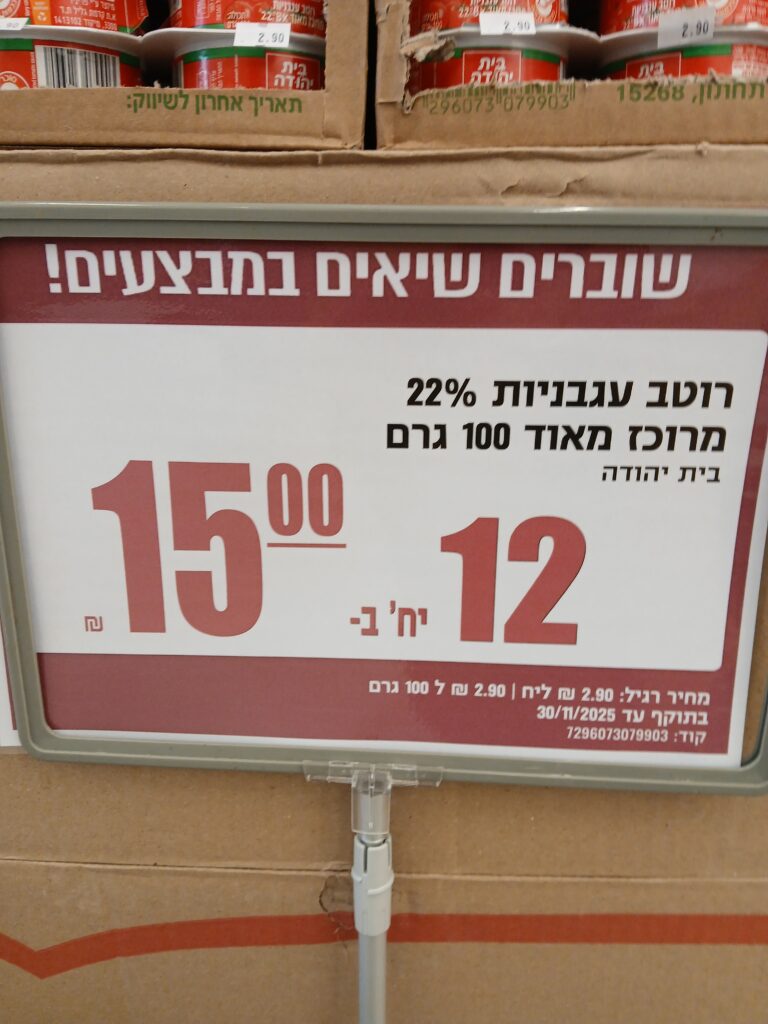
The usual price is 2.90 each/2.90 per 100 gram. At the regular price of both items, we can see that the smaller container is much more expensive. What about now that it’s on sale?
First we need to figure out how much one container is: 15 divided by 12 is 1.25 per container/1.25 per 100 grams, so we can see this is also a good sale of more than fifty percent off. But is it a better price than the larger container above?
To know that, we need to make one more calculation: how much is the unit sale pricing is for the larger container? To make a price comparison, we need to know how much 100 grams is for each one.
To figure that out, we divide the total cost by the total weight in grams: 3 shekels for the larger container, divided by 260 grams is .0115 per gram, times 100 is 1.15 shekels per 100 grams.
So what’s the better price? In this case, the large size at 1.15 per hundred grams is a better deal than 1.25 per hundred grams, even though the percentage savings on the smaller size is higher.
Now, it may be more economical for you to buy the smaller size because you the bigger size is too much for you and would be wasted. But now you can make that decision based on the numbers.
While it’s wordy to explain how to do price comparisons and sounds like it must be time consuming, it generally takes just a quick moment to do some figuring.
Does all of this nit picky detail really make a difference to how much you spend on groceries? Yes, it matters tremendously because small things add up to big numbers. I routinely save thirty percent or more off my grocery shopping, by looking for sales and paying attention to unit pricing.
Avivah
2 Responses
My husband is very good with checking prices. I am learning and when I find a sale I am very excited to tell my husband.
I’m sure he appreciates your awareness of expenses!