
There’s been a lot of exultation being expressed about the changes to the US dietary pyramid recommendations, and my initial response on viewing it was to be pleasantly surprised.
I know that RFK eats a diet very similar to mine (close to carnivore) and he’s very knowledgeable about real nutrition, but I couldn’t imagine how any meaningful changes would be supported.
When I saw the new food pyramid picture, I thought it was too good to be true. After all, a lot of money would be lost by major food producers if these guidelines were followed. Not only that, the masses of people with improving health would create a huge financial loss to the pharmaceutical industry. Tremendous earnings are involved in the food pyramid and the stakes are very high – for the individual’s health, and for the revenue potential of the biggest companies in the US.
There are a lot of lobbyists battling to keep the status quo, and I presume that every single bit of change on this pyramid was fought for. I give a lot of credit to those who pushed for the changes.
Here are the specific guidelines of the new pyramid, ten pages in all. It’s worth reading because you’ll understand the most important detail is one you might think insignificant.
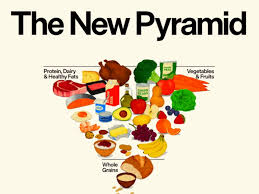
First, the good news and improvements are immediately visible. Look at all that beautiful whole food! Look at meat, chicken and cheese being the foundation of a good diet! All high fat, high nutrient density foods, long been demonized and now being highlighted as ideal.
Look how carefully the lower carb vegetables make up the higher amount of the diet, with low carb berries and avocados close to the foundation; sugary fruits like bananas and grapes are listed higher up, being they should be eaten more moderately.
All this is amazing. So much of what they wrote in the guidelines is really good. Not perfect, but very good.
Healthy fats are part of the healthy foundation. Let’s look at the literature to see what they’re calling healthy fats (it’s pretty much aligned with what I wrote in my 2009 article about healthy fats). I was happy to see the following, making for a long overdue official policy change in the attitude towards saturated fats.
“Incorporate healthy fats: Healthy fats are plentiful in many whole
foods, such as meats, poultry, eggs, omega-3–rich seafood, nuts, seeds, full-fat dairy, olives, and avocados.”
“When cooking with or adding fats to meals, prioritize oils with essential fatty acids, such as olive oil. Other options can include butter or beef tallow.”
What??? Butter and beef tallow? Long claimed to be heart clogging, now being listed as fats to prioritize? I thought for a moment that angels were singing.
And then I came to the next line, and this is the nail in the coffin for this food pyramid:
“In general, saturated fat consumption should not exceed 10% of total daily calories. Significantly limiting highly processed foods will help meet this goal. More high-quality research is needed to determine which types of dietary fats best support long-term health.“
Let’s ignore that mealy mouthed, wishy washy final statement. There have been tons of studies done and we know what dietary fats support long term health: saturated fats. This statement was clearly included to appease someone.
Let’s look at the other two sentences before that. Do you think that fast food is high in saturated fat? Do you think that highly processed foods are high in saturated fats?
Not if they’re prepared with seed oils they aren’t.
All a processed food producer of a high saturated fat product needs to change to be within guidelines is to shift from palm oil to canola. Then their labels can claim they meet the health guidelines, making them appear to be a healthy option.
If limiting processed foods isn’t going to keep your saturated fat intake down to 10%, what will you have to limit?
You will have to cut down your intake on the exact foods that are listed as foundational: meat, chicken, eggs, butter, tallow! So logistically speaking, these are the foods that will have to be minimized to fit the guidelines of the recommended diet.
The protein guidelines have been increased, which is great. What can be served that will meat the increased protein guidelines, and stay within the 10% saturated fat cap?
Plant proteins.
You don’t see plant proteins pictured in the new pyramid, but they are mentioned in the document and it’s the details that matter, not the hyped up picture.
What fats will they use, if they can’t use saturated fats without going over the guidelines?
Seed oils.
You may say, who cares about the details? These are great changes! No one reads the specifics of the guidelines; people will look at the picture and will be encouraged to eat more of those high nutrient dense foods.
For the individuals who do that, it’s a huge gain for them.
HOWEVER. All food served through federally funded food programs will need to align with the guidelines. How many people does that affect? All school meals (60% of school children get school lunches), elderly food programs (1-2 million people), food programs for the poor, military, and prison meals (2 million adults) need to comply with the guidelines. All food in hospitals and nursing homes will have to comply with these guidelines. That’s a huge percentage of the US population that is affected by these guidelines.
You see, the food that is government funded to many millions of Americans isn’t going to change much at all. I’m guessing the biggest change to the government approved menus, will be Pop Tarts being replaced by the Impossible Burger. I am really skeptical that will produce notable gains in health.
Presumably nutritionists and doctors will be trained using these guidelines, and again, they’ll be promoting nutritional information that is very limited and won’t result in good health.
(I found an article detailing the issues with this pyramid by Nina Teicholz, author of The Big Fat Surprise: Why Butter, Meat and Cheese Belong in a Healthy Diet. It’s definitely worth a read, since she was on the inside trying to pass meaningful changes that would benefit the health of the US citizens.)
Now you understand how these guidelines could pass. It’s not going to make nearly as many changes to the health or pockets as it would appear at first glance.
——————-
For me, it doesn’t make a difference one way or another what the guidelines are. I’ve done my own research over many years about nutrition and other aspects of health. I’ll continue to do those things, whether they are recommended or not.
Every one of you has the ability to take responsibility for your own health. It’s literally in your hands, the hand that puts food in your mouth.
Don’t abdicate that responsibility to anyone else.
Don’t be distracted or confused by what politicians are saying or not saying.
Keep your focus on your own choices, and keep taking the next step in the direction towards better health.
Avivah
2 Responses
I see what you’re saying, Avivah. I was also pretty excited about the new food pyramid, though I hadn’t read any of the fine print! I hadn’t thought about institutional food and how that will have to change to meet the guidelines and what the repercussions of that are, when they’re still recommending limited saturated fat intake. Sigh.
I also think the new changes are great! They just are contradictory to what official meals according to the guidelines will look like.
It’s progress, not perfection, right?