
I was listening to a podcast about home organization on the Clutterbug YouTube channel, and found the classification of individuals by four organizing styles insightful and completely on target.
She groups people by those who prefer visual abundance or visual simplicity (want to see their stuff/don’t want to see their stuff), and how they store and organize their belongings.
These preferences combine in four ways; each type has its own challenges and strengths. Each type has an organizing approach that will be most effective for them. She gives each classification a ‘bug’ name: Bees, who are visual (want to see their stuff), detailed organizers; Crickets, who are non-visual (don’t want to see their stuff), detailed organizers; Butterflies, who are visual, general organizers, and Ladybugs, who are non-visual, general organizers.
I was very surprised to learn that there are people who want to see their stuff. I feel stress when things are out and calmed by having them put away, and wouldn’t have imagined there are those who are stressed by having their belongings out of sight.
Listening to her talk about the Ladybug style, I was struck by how much of what I do and am ramping up as of late, is exactly what she recommends for those with this organizing style.
I’m a Ladybug and have intuitively been calming my environment and by extension, my nervous system, by creating visual simplicity. When I’ve done this in the past, I thought of it as decluttering and reorganizing but I love the term she uses, ‘visual simplicity’, because this (in addition to simplifying how things run) is the point of my decluttering and organizing.
Reorganizing my spices and kitchen storage? Creating visual simplicity.
Making fabric boxes to organize closets? Creating visual simplicity.
Buying closets and beds with built-in drawers? Creating visual simplicity.
Now I’ll share with you my dilemma about my dining room set.
I bought a second-hand dining room set five years ago, and it had all the features I wanted: extremely well-made, pedestal base to enable maximize seating (no annoying table legs to get in the way), and easily extendable leaves that were stored in the table and opened to a very nice length. It was hard to find all of those features in one set, and when I finally did, I asked my husband to purchase it and bring it home.
There was only one problem, one that I didn’t notice in the pictures. Do you remember when the distressed furniture look was popular? That means, the manufacturers purposedly scuffed the edges of the chairs and table before sealing it. Even when it was very popular, I never liked this aesthetic. Why would anyone want new furniture that looks used? I don’t even want used furniture that looks used.
This set was distressed, and I didn’t see that until my husband brought it home.
Oh, no. But it was here, and it was excellent quality. It worked really well for our needs, something I constantly reminded myself of.
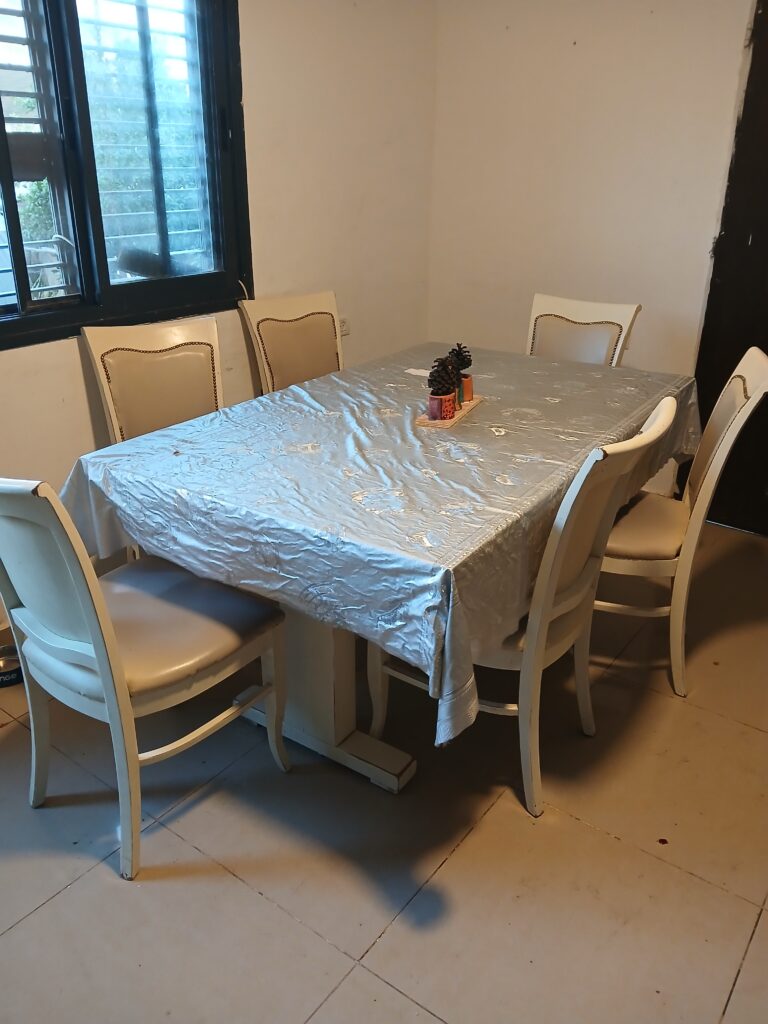
It had this wonderful extendable track system with four leaves that stored inside, so we could easily extend the table for whatever size crowd we hosted. The chairs were amazingly sturdy – all the chairs we had before these eventually got shaky, but these took a beating and kept going without a wobble. We had them reupholstered with a durable leather-look vinyl, and they were so easy to clean.
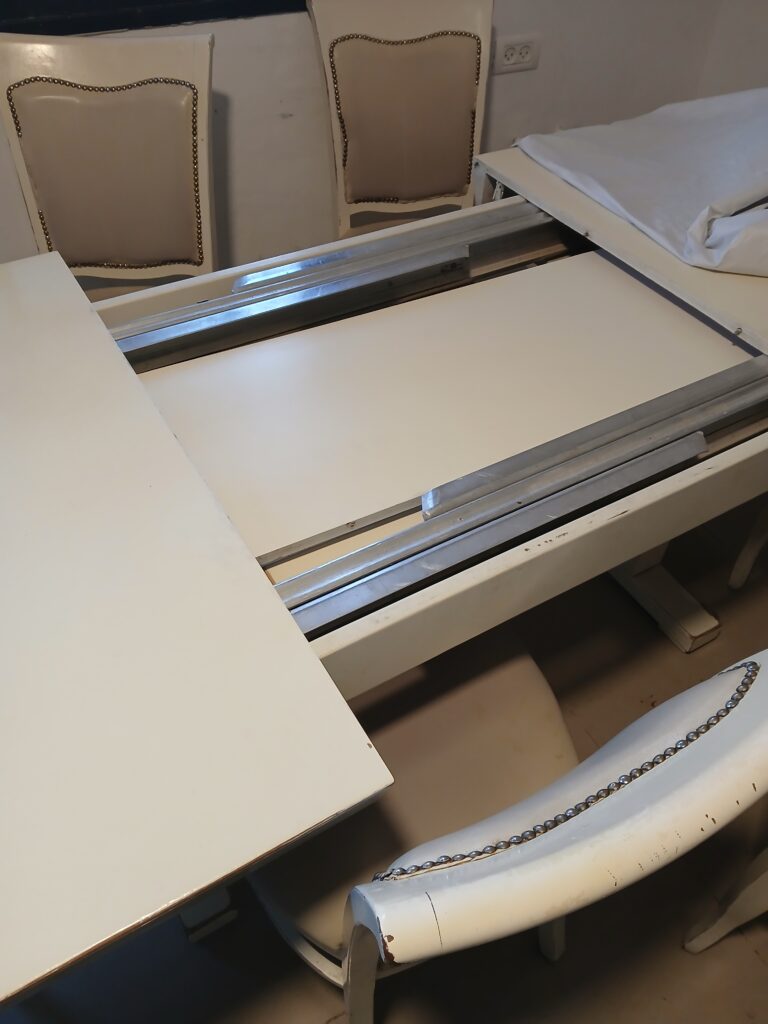
I really appreciate quality and durability, but even with that being so good, I couldn’t not see the scuffing.
When I was looking around at things in my environment that weren’t calming for me, my gaze settled on my dining room set. I’ve been looking for a different set for over a year, but I’ve continually talked myself out of it, time after time: “But it suits our needs so well. They don’t make quality like this anymore. I’ll never find something this well-made.” Etc, etc.
But now, recognizing the impact my visual environment makes on me, I determined, that’s it. I want to feel good when I look around my home.
I’m not going to keep this set even though it’s made to last forever and I have children who are very rough on furniture, and might soon damage something new. Do I not allow myself to have a home that feels good to me, just because I’m raising young children?!?
I want something that gives me a good feeling when I look at it, not something that adds to my discomfort.
With continued movement towards visual simplicity, I want a table that has a waterproof tabletop, because I don’t want to have to keep a protective tablecloth on a wood table. Ds8 usually damages the tablecloth within a short time of gettinga new one, and then I, the person who can’t block out all these details, has one more annoying thing to notice until I once again replace it.
No more tablecloth during the week.
I also would like something with a smaller footprint, something that will visually open up the area. I love open space. (It’s probably connected to not liking to see items around.)
When I found the new (used, 2 year old) set I wanted, I was concerned that my husband and teen sons were not going to be happy about it.
It’s the same length as our old table, but it’s narrower. It has a tempered glass top. It has a pedestal base. It’s really well-made. But it has only one extension.
If I was going to have to compromise on something, this was a compromise I was willing to make. In the coming year, when my 17, 18.5 and 20 year olds will be home only once every few weeks, it will be big enough for us all. When we have additional guests, we’ll pull out a folding table.
I was a bit anxious about getting this set, thinking the other adults in the family would likely prefer to stay with the status quo. But I moved beyond my discomfort.
Here is the new set:
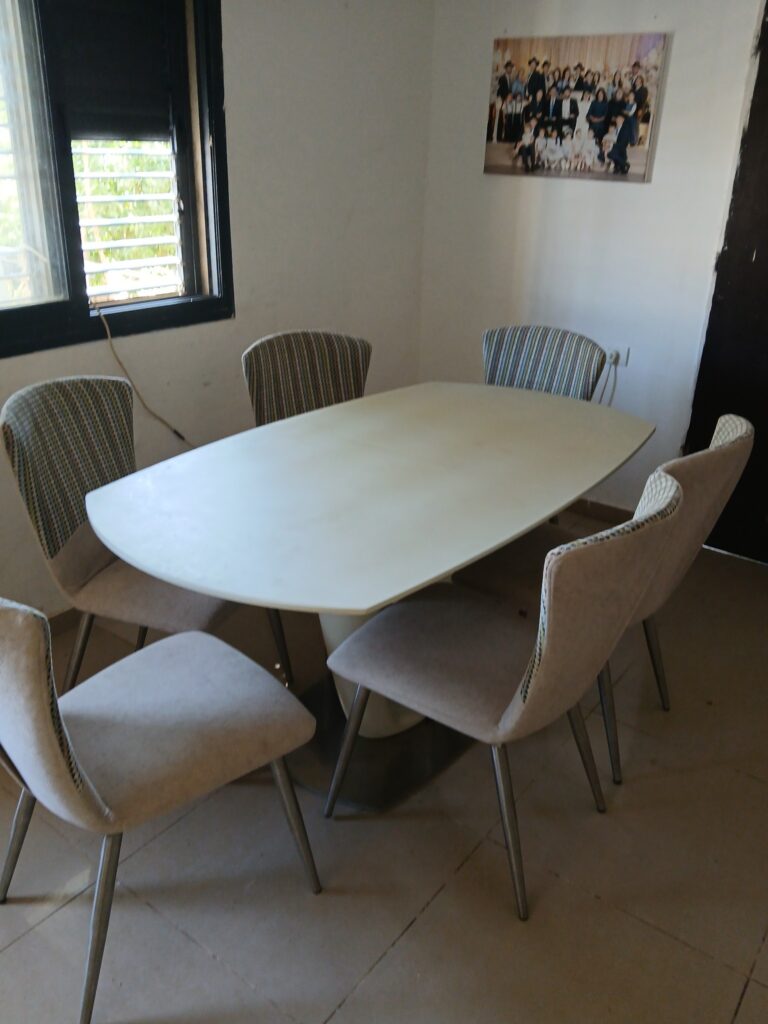
When my husband went to pick up the new dining room set, all he said was that it was very heavy. He repeated that a second time the next morning – again his only comment.
But once it was put in place, he surprised me by telling me how much he liked it. A lot. He liked how it made that corner of the house feel more open.
Here it is open with the extension.
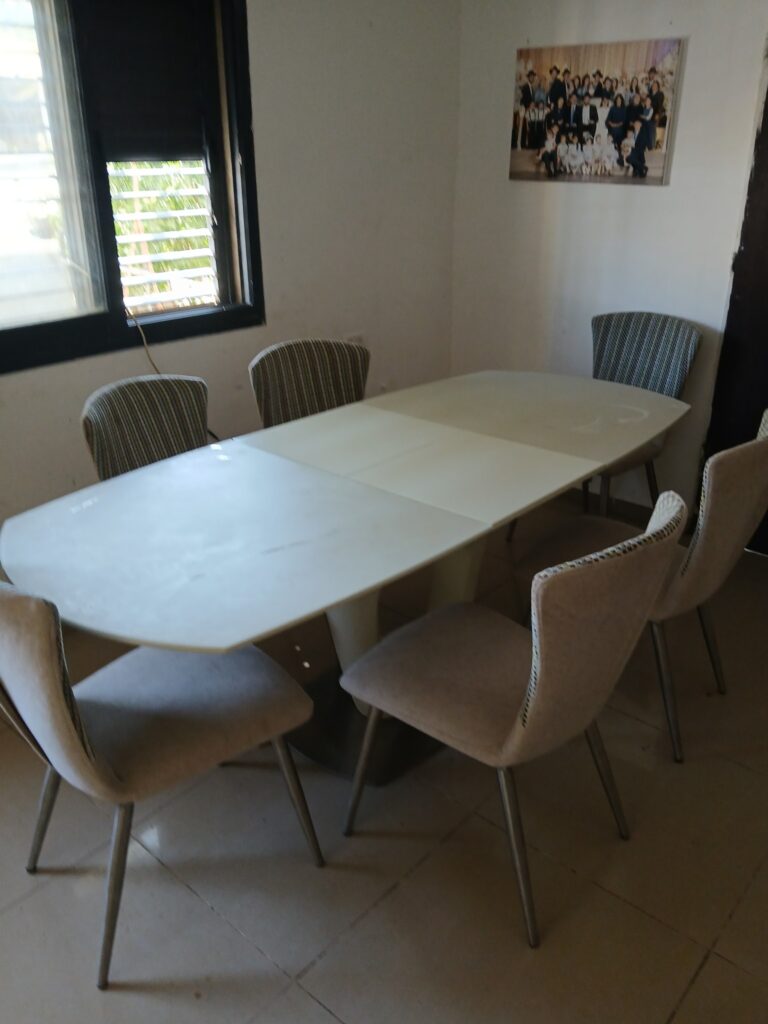
The chairs have a strong metal frame and are covered with a washable fabric. The washability was tested in the first 24 hours by blood stains, peanut butter smudges and tomato splatters, and it was a relief when it all came out.
The boys all surprised me by saying it was really nice!
My takeaway is that if you care about something and have the ability to make a change that supports you, do it. I got a super good deal so the cost was extremely reasonable, and making this switch felt like honoring my preferences, instead of overriding them with logical justifications to keep things as they were.
This wouldn’t be important to someone who isn’t as impacted by what she sees as I am. For me, these things make a big difference.
It’s worth the time to learn what your organizing styles is, so you can set up systems that will work for you, and continue to be maintained. Most organizing systems on the market are perfect for Crickets (non-visual, detailed organizers) but won’t be effective loner term for the other three types of organizer.
I found it validating to learn which of the four styles I am. Understanding my style also is helping me give up the belief that the answer to things being messy in my home isn’t to convince myself it’s inevitable because of my children and to try to be more relaxed about it.
This has given me permission to make changes that calm my outer environment and not see it as being self-indulgent, but recognize it as being respectful of my preferences.
Avivah
3 Responses
I also find Clutterbug very validating. I’ve been a “bee” all my life. I used to get physical revulsion whenever I looked at home organisation books with these completely clear surfaces. I felt it looked like a mental asylum, not a lively and happy home. Whereas I love images of rustic cottages with mismatched furniture, plants and books and art work everywhere in a stimulating and cosy pattern. I also actually need to see what I have to properly deal with it.
Thankfully my husband is similar and our children are children so they just enjoy being able to make a mess and have toys everywhere. However we had so many critical comments from relatives about the “disorder” in the house when I saw it as well organised and comfortable as I knew exactly where everything is and where it belongs. They must have found it overwhelming and probably could not understand not everyone is like that.
I find though that with more young children I’m slowly moving towards wanting less visual clutter to balance out the stimulation from the noise and energy surrounding me. So maybe it’s not a fixed thing?
I love that you’re also familiar with this system! I find it fascinating to understand how differently people organize their space and feel good in it, and learning about the different styles has helped me appreciate others more deeply.
I do think that when there’s a lot of noise (internal or external), a person will naturally want to quiet aspects of the environment around them, because whatever is going on is maxxing their capacity. I very much feel like that right now – my tolerance for things out of place around me is much lower than it usually is, because of the emotional pressure I’ve been under, and I *need* to have things more streamlined right now in order to keep my emotional equilibrium.
Actually I just noticed the image of a house with coats, shoes etc in the front page of your website and it’s exactly the sort of living space I love, so many cosy things in few perfectly organised and a busy view from the window. So funny to think how different we all are.