Yesterday dh and I needed to go to an office at the bottom of Karmiel, and while we were there, did a little bit of shopping in the area. We saw some pillows marked at 30% off, and looked to see how much they were – just 70 shekels each after the discount!
To buy ten pillows for our family, this would have cost us a hefty 700 shekels. And this reminded me that I didn’t share with you about my pillow making adventure.
For about seven weeks after arriving here in Israel, we didn’t have pillows. Everyone used some item of clothing pushed into a pile under his head at night, and though it wasn’t ideal, it was manageable. I wanted to buy some, but the choices I found weren’t great: the second hand store had cheap pillows for just 5 shekels each, but I had no desire to let any of my family members rest their heads on the majority of the pillows there (I did find two good ones, though). Then I saw some new pillows that were just 15 shekels each at the bargain store, but were so flat that I knew after using them for a night we’d hardly feel there was anything under our heads! And lastly are the higher quality pillows like those we saw on sale yesterday, which is really the kind of pillow I wanted.
Dh isn’t yet working, and we have to be conservative about our expenditures, so spending hundreds of shekels on something like pillows, that are nice but you can’t really call them essential, didn’t seem prudent.
Right around the time I was checking out the pillow purchasing options, I passed a leather couch set out on the curb that was being given away. The cushions you would sit on were ripped, but the back pillows were in perfect condition. I passed it, thinking it was too bad there was nothing I could do with them. And passed the same couch a second time a little later that day, and then the third time I passed it the same day, a light went off in my head!
Since the cushion covers were leather, it was safe to assume that no one had drooled on the inner cushion, wet it, or done anything else that would make it disgusting. I realized I could use the inner cushion to make pillows with – they were good quality cushions with good quality stuffing.
Here's one of the cushions
Dd10 and ds9 were with me, so each of us grabbed one – two large ones from the back of the sofa, and one smaller one from the side of the sofa. (I didn’t take the second small one because the zipper was opened a couple of inches, and I didn’t want to worry if anything could have gotten in.) When we got home, I saw that they were constructed differently than I had anticipated, and my first idea for recreating them wouldn’t be as easy as I thought.
I found a couple of sheets we had been given that were in the give away bag, and started cutting, using the material in a way to minimize the sewing I’d need to do (ie the fold of the sheet became the length of the pillowcase on one side). One was a crib sheet, which I turned into two matching pillow cases. A twin sheet yielded four matching pillowcases, and the inner casing from the original couch cushions became the remaining three pillow cases. I unfortunately couldn’t bring my sewing machine along when we moved, which would have made this project super fast. But I compensated by doing a running stitch by hand to quickly sew the material together, and I was able to do this with the kids around while interacting with them, so though it took some time, it wasn’t a big time sink.
Once I had a case closed on three sides, I let the littles fill them with foam. They had fun with this, though their enthusiasm did lead to an extra mess! After we stuffed in the amount we wanted, I sewed each pillow shut. It’s especially nice that since this is industrial quality stuffing, it’s soft but denser than what I’ve seen in craft store so these pillows won’t turn into flat pancakes anytime soon!
Some of the pillows, looking a little lumpy before being smoothed down
By reclaiming and recycling materials that were available to us, and equally importantly, by looking at those materials with the willingness to think creatively, “What can I do with this?”, we now have nine new pillows that didn’t cost us a penny. Not only that, I saved the inconvenience of traveling on the bus to get them and bring them home, which would have been significant with the amount of pillows we needed.
This recipe is so easy, and so inexpensive! It’s hearty and filling, perfect for cold autumn and winter days.
Viking Stew
1 large head of green cabbage, chunked
a few sweet potatoes or winter squash, peeled and chunked
1 large onion, peeled and chopped
1 – 2 lb meat chunks (chicken or turkey chunks are also good)
2 – 3 fresh sprigs rosemary
salt to taste
Mix all of the above ingredients in a roasting pan, and cover. Bake for two hours at 350 degrees. Then eat and enjoy!I currently am paying 2 shekel a kilo (about .35 lb) for cabbages and onions. This makes it the cheapest vegetable currently being sold here. We bought three cases of butternut squash last week for 15 shekel, and I have yams that we were given. For the meat chunks, I used diced giblets (also called gizzards, but I dislike how that sounds), which I bought for 5 shekels a kilo (about .75 lb). And since rosemary grows all over Karmiel, I send one of the kids to go out and pick some fresh when I need it. (As I mentioned in yesterday’s menu planning post, I make a menu based on what I have on hand – this is a big part of why my food budget stays so low.)
The menu below integrates planned leftovers (I purposely double ingredients when cooking so I don’t do double the work – eg, when cooking chickpeas for Shabbos, I made lots so I’d have some cooked for stew on Sunday). And during the week if I have a bit of something left over from one meal to the next, I either repurpose into something else (eg some cooked veggies will end up being added to a stew), or eaten in addition to the meal itself as a side dish if there’s enough of it. My goal is to get to the end of the week with a minimum of food storage contIf I link to a recipe with ingredients you wouldn’t think I’d use, then I’ve taken the basic idea and then adapted it. 🙂 There are very few recipes I use as is, but it’s easier to link and adapt than pay attention to the measurements I use and post my own version.
lunch – challah, techina, Moroccan carrot salad, pepper salad, marinated chickpeas, baba ganoush, eggplant and red pepper dip, savory beet salad, cabbage/lettuce salad (I have to think of a good name for this, since it’s really good!), squash pudding, potato kugel, onion quiche, chicken, lemon squares, rugelach
Thursday – b – fried eggs, pepper strips; l – chicken pot pie; d – CORN (clean out refrigerator night)
Friday – b – oatmeal; l – lentil barley stew
On Friday afternoon, dh went shopping for vegetables, and since I didn’t have a chance to unpack them all that day, I spent part of this morning organizing my pantry. Though I don’t have the space to store foods bought in large quantities, I have made enough space to be able to take advantage of good sales, so I usually have vegetables left from one week’s purchase to another. That means putting the older vegetables in the front so they get used right away; otherwise, bargains can easily turn into losses if they spoil before they are used. And then I take a look at what I have in my pantry and fridge, and plan my menu for the week based on that.
I started a big batch (4 gallons) of curried carrot sauerkraut on Friday (well, let me be honest – I delegated this to ds12), but still need to add some onions, garlic, and purple cabbage to it. Right now it’s just green cabbage and carrots – but it’s a lot of it! Fortunately, you can add vegetables to a ferment after it begins fermenting.
This morning, I started a pot of chicken broth to use for the next couple of days. It goes really fast around here, and I miss the free turkey carcasses I used to be able to get, that allowed me to constantly make huge pots of broth for pennies a pot. What I’m doing now is buying whole chickens, which is the cheapest kind of chicken here (aside from giblets and wings), cut it up and debone it. Then I put the bones in one bag in the freezer for broth making, and the other parts in another bag. (I try to keep the white meat separate, since it dries out if I cook it with the dark meat, but is excellent when cooked well.)
With the cold weather coming up, everyone will enjoy hot soups, and I like to use broth as the base for all my soups – it not only adds lots of nutritional value, but it makes a regular soup really, really good. (I sent a thick potato soup to a neighbor a few months ago, and her husband kept exclaiming over how amazing it was – based on the ingredients in it, he couldn’t figure out why it was so delicious! Broth, a cook’s best friend. 🙂 )
(As always, feel free to request a recipe if you see it listed and there’s no link.)
After my post in September in which I shared about great used clothing bargains I found, I was asked by a number of people for the details on where I went. I don’t track my readers, and though I know there are people reading my blog in a number of different countries, it’s been an eye opener that so many people in Israel were reading this well before I moved here!
There are clothing exchanges (gemachim) all over the country, but I don’t know about most of them yet, and probably won’t, since I’m not going to travel all over to get used clothing! Here’s the details on where I went in Ramat Beit Shemesh, which is about a forty five minute drive from Jerusalem.
1) 23/2 Reviim – this is where I started, and where I recommend anyone going starts out. Their prices are the least expensive and there’s a very large selection. The woman running it is an incredibly special person who a good friend of mine has told me about for years who I had long wanted to meet – I was just sorry to learn what her last name was later that evening, after I was long gone! The prices are 2 shekels for a pair of shoes, 2 shekels per item for kids ages 12 and under, 3 shekels an item for over age 12.
Dd11 is tall for her age, so the clothes I bought her were size 16 – 18 (girls), but I was told that since I was buying them for someone below the age of 12, to pay the children’s price. That was very nice, don’t you think?!
They also have backpacks, purses, some linens, and tzitzis. I think the backpacks were a shekel each, I don’t remember now for sure, but the tzitzis were definitely a shekel a pair. That was an amazing price since I needed a few pairs, which would have cost me about 30 shekels each. The woman who runs this is an English speaker.
2) The second place I went wasn’t a clothing exchange, but was a person who every couple of weeks does a used clothing sale. I’m going to include her information here, since she does it regularly enough for it to be a good resource to be aware of. Her address is 3/16 Nachal Zohar, the third floor. You can call her beforehand to find out when she has a sale – 050-678-9422. She is a native French speaker, so you’ll need to speak to her in Hebrew unless you speak French.
The used items were 5 shekels each, and she had a bargain box of things that were damaged or for whatever reason not selling (eg kids clothing with words on it) – anything in the box was 3 items for a shekel. She also has brand new things – I bought brand new womens’ skirts with the tags still on for 10 shekels.
3) 40 Sorek – this is the most expensive of the places I went, and I think it’s good to go to the most expensive places last – if you can find what you want more cheaply, than why not? The entrance to this isn’t in a building, but down a huge flight of stairs outside – maybe three flights down? This is also run by a lovely woman who is an English speaker.
I believe the prices were 5 – 20 shekels per item; 5 – 10 for children’s clothing, depending on what it was, and the ladies clothing was 10 – 20 per item. There were some very nice things there and you can really find something lovely for Shabbos or the holidays.
For my Israeli readers: have you ever gone to any of these places? Are there other gemachim that you’d recommend and can share the address of? For my non-Israeli readers: where have you found great bargains on clothing?
Well, it’s happened – five more of our children have come down with chickenpox in the last 36 hours, two weeks after ds5 came down with it. 🙂
Fortunately, there are a number of things you can do to alleviate the discomfort of chickenpox. I’ll start with homeopathy.
Homeopathy:
a) If you recognize the chickenpox early on, give aconite. This will bring it to an end very quickly, without compromising the immunity benefits of getting chickenpox. I learned about this over twelve years ago from a friend who used it at the first sign of chicken pox, and it was over in a day. I couldn’t find a local store that sells homeopathic remedies, was fortunate to find a friend in the area with a homeopathic kit from whom I was able to borrow the two remedies I needed, but not in time to give the aconite to ds12 and dd10, who broke out first. But I am giving it to ds2, ds4, and ds9, and their cases are (so far) significantly lighter than the two older kids or ds5.
b) Then there are some other remedies you can give, but the main one I’ll mention here is rhus tox. Rhus tox is good for alleviating the itching, and I’m giving the two older kids rhus tox 30x (3 times a day for 48 hours).
c) Chamomilla is a good remedy for soothing.
Baths:
Lots of people recommend Aveeno to relive the itchiness of chickenpox – but do you know what Aveeno is? Oatmeal! So open up your pantry and use the oatmeal you already have there, and it will be lots cheaper and just as effective. I put the oatmeal in a knee high nylon and knotted it at the end, to allow all the helpful substances in the oatmeal to seep out, while keeping the oats themselves out of the drain. Ds5 had a great time playing with this in his bath, and there was no mess at the end when I let the water out of the bath. The older kids didn’t play all day long in the bath like he did, but they also found it soothing.
I added some herbs to the oats to speed the healing: chamomile and comfrey. The chamomile is for soothing, and the comfrey is to help soothe the itching and heal the pox. (I was so glad I decided to bring my medicinal herbs along with me when I moved!) I used a tablespoon of each herb combined with a cup of rolled oats (I chopped the oats in a food processor but this isn’t necessary). Lavender is another good herb to include in the bath.
A couple of other things that can be helpful in baths are baking powder, and powdered ginger. With ds5, I sprinkled baking soda on the damp pox to alleviate itching. I didn’t bring along the large containers of powdered herbs that I used for cooking as well as for medicinal purposes (like mustard, cayenne, and ginger), so I didn’t use that.
Another herb that is soothing is slippery elm powder; it can be applied directly on wet pox.
Cool baths are more soothing that hot baths, which can exacerbate the discomfort of itching.
Herbs:
All of these herbs are good when brewed as tea: lemon balm, echinacea, St. John’s wort, ginger, pau d’arco, and burdock. I have most of these, but chose to make ds12 some tea with echinacea and cut stevia (the leaf) for some sweetness. All of these would be good added to the bath, as well.
Essential oils:
Before I moved eight weeks ago, I bartered fifty pounds of spelt berries and six pounds of natural beeswax for several small bottles of essential oils – lots easier to bring with me!! Naturally, of the four oils that I now have on hand, I didn’t have any oils that were of help in this situation.
Here’s a couple that can be diluted with a carrier oil or some chamomile tea and applied to the pox: tea tree oil and lavender oil. A few drops can also be added to bath water.
Vitamins:
When dealing with any cold or infection, it’s good to build up the body’s resources to aid it in fighting germs. Vitamin C, vitamin A, and vitamin D are always good for any kind of cold. (I posted guidelines for vitamin C dosing here.)
Vitamin E oil is great to apply on the pox to reduce scarring. Coconut oil can also be helpful when applied to the pox.
Nutrition:
Good nutrition is always important, especially when a child is under the weather. Now’s not the time to give them sugary treats to make them feel better; they’ll be happy for the moment but it will slow their healing. Lots of liquids are important to keep your child hydrated; I made a huge pot of chicken broth with garlic and astragalus that we’re going through quite quickly!
Some other external things that can be applied:
Calendula cream – helps to heal pox after they’ve scabbed. Witch hazel can also be applied to help dry the pox out.
What not to use:
I’ve always thought of calamine lotion in the same breath as chickenpox, but after learning that it’s suppressive, didn’t go out to buy any for this go around with chicken pox. While it dried up the lesions, it keeps the toxins from exiting the body through the skin like they need to – you always want to allow the disease to leave the body!
Similarly, I personally try to stay away from fever suppressing drugs – eg Tylenol, Advil, Motrin, aspirin, etc. I believe that fevers aid the body in healing, so when a child has a fever that spikes (like ds12 right now), I use sponge baths or a damp cool cloth on the forehead to relieve excess heat.
Have any of your children had chickenpox? What tips have you found helpful in alleviating their discomfort?
If peanut butter is a something you use a lot of, you might want to consider buying a bunch now and lock in the savings while prices are still low.
Wholesale peanut prices have more than doubled in the last year, and according to the Wall Street Journal, the major peanut butter manufacturers have announced their intent to raise prices from 24% – 40 % (Peter Pan is only going up 24%, Jif – 30%, Planters – 40%). These prices will go into effect by November. I haven’t seen any prediction regarding the prices of nut butters , but it’s very likely that since people already expect to pay more for those items (eg cashew, almond, sun butter), that manufacturers may decide to hike their prices and keep the gap between peanut butter and specialty butters in place.
Peanut butter can be stored for a long time without losing freshness, and by buying at today’s cheaper prices, it’s as if you’ve made 24% profit on your food dollars. With the pathetic savings rates right now (my bank is giving us a whopping .25 %), this is significant!
I’ve said it before, but it bears repeating – by stocking up when prices are low, you’re making your money work for you. Using the information you see in the news can help you make informed purchases that will benefit your pantry. 🙂
Yesterday we had a fun pre-Rosh Hashana outing – pomegranate picking!
Pomegranates are one of the symbolic fruits traditionally served on Rosh Hashana (the Jewish New Year), and picking them was not only fun but very timely! We found several pomegranate trees in the vicinity on public land, and yesterday the kids picked a bunch for us to use.
Here’s the pickings, minus a couple of large ones that they shared when they got home.
Ds5 with the 'pickings'
I’ve always enjoyed pomegranates, but found them a pain in the neck to eat. They’re just so much work! But lo and behold, I’ve learned an easy and effective way to quickly deseed them, with hardly any juice stains – dd15 could hardly believe how easy it was when she tried it.
Rather than describe it for you,here’s a very short and clear video that I found very helpful: http://www.youtube.com/watch?v=rnujQquKCQY&NR=1. It really is as easy as he makes it look.
This was a fun, frugal, and fruitful (no pun intended!) outing! And after seeing us picking pomegranates yesterday, a teenage neighbor today told my daughter her family also picked some for Rosh Hashana – they had seen the trees but never thought of it before!
I’m thinking of picking more pomegranates to preserve – but I’m not sure what to do with them! I need ideas! What do you use pomegranates for (juice, concentrate, seeds)?
Since I’ve arrived in Israel, I’ve bought a huge amount of produce – it’s delicious and affordable. I choose to limit myself to the purchases of produce that is 3.99 shekel a kilo (about .60 lb) or less but right now just about everything is within ten shekels a kilo. We’ll see how the prices change as the season changes, but for now we’re enjoying lots of cucumbers, tomatoes, eggplant, onions, peppers (green, yellow, red, orange), cabbage, butternut squash, beets, and potatoes.
One vegetable that used to be a staple in our house that I haven’t been using here is yams. Priced at 6.99 or 7.99 a kilo, it’s about double my predetermined limit. However, on Thursday I was at a local store and saw yams for 2.99 a kilo. My stock up instinct kicked in but it was the end of the day and the supply was low, so I was only able to buy about 7 kilos.
Why were they so cheap? Because of this.
Large potato next to super large yam
The yams on sale were all huge, not the typical size that is going for full price. They might have been grown in the same field as the more expensive yams, and picked and harvested the same day, but because they aren’t standard, they aren’t seen as desirable. We’ve become so used to perfect looking produce that people feel that something is wrong with produce that doesn’t look exactly like what they’re used to seeing, when in fact what’s normal is that fruits and vegetables have lots of variation in size and shape. So that provided those of us willing to overlook what is considered cosmetically attractive the opportunity for a great deal!
For me, big yams like this aren’t an inconvenience, since when I get smaller ones I have to use lots more of them. There’s more work involved in peeling smaller ones, more work involved in cutting larger ones, so they pretty much even out in terms of effort. We enjoyed these for Shabbos in a sweet potato pie with crumb topping, and they were delicious!
Do you ever buy discounted imperfect produce? What kind of store do you find it in? What are the prices like?
Living here in Israel, my food buying habits have somewhat changed (I haven’t yet been able to find a bulk supplier and the stores here are obviously different), but overall my approach to shopping frugally has stayed the same.
One strategy that I consistently apply is to buy and use primarily what is on sale or cheap. This past week, I saw that chicken gizzards were on sale. In the US, gizzards were about $3.29 a pound, so they were always too expensive to buy. But here, I was able to buy a kilo (2.2 pounds) for 7 shekels, which at about a dollar a pound, is the least expensive meat option I’ve seen so far. So true to my pattern, I bought ten kilos (22 pounds); a few days before I had bought all they had left, just five kilos.
I brought them home and immediately put them all in a large pot to cook. Gizzards take a long time to cook – if they are undercooked, they are chewy and have a not quite pleasant consistency – but if they are well cooked, they are as soft as butter and really tasty. The key to cooking gizzards is to cook them long enough, until they are very soft. My kids love these, and told me it’s their favorite kind of meat now!
The other thing about gizzards is they tend to be salty. They become less salty with cooking, but still are saltier than your average cut of chicken. The way I deal with this is that I use less salt in the recipe when I’m using gizzards, and it balances out well.
It takes the same amount of gas to cook a small amount as a large amount, so it made sense to cook all that I had at one time. That helps keep fuel costs down. Also, cooked chicken takes up less space in the freezer than raw chicken, so it’s more space efficient as well.
Once they were all cooked well, I drained them out, saving the gravy to cook with. I chopped them up since I plan to use them in various dishes and that’s the size that will work best. Then I bagged them into one kilogram packages, and froze them.
Thirteen bags of cooked, chopped, and frozen chicken gizzards, ready to use!
What can you do with chicken gizzards? Well, once prepared like this, you can use them in the same way you would use chopped chicken. There are so many possibilities, and utilizing these inexpensive chicken parts has been a very frugal and delicious addition to our meals. And preparing them in this way means that I have a nice supply in the freezer for a number of meals, ready to go!
We aren’t yet finished furnishing our new home, but we’re getting close! Today I want to share with you what we bought, and how much we paid for each item. Initially I was shying away from sharing these details, but then I thought about those who would find it helpful to have hard figures to work with in estimating costs of used furniture in Israel, and general comments about ‘finding a good deal here’ or ‘much cheaper in America’ aren’t super helpful.
To get an idea of what we’d have to expect to pay for used furniture, I casually skimmed an excellent website called yad2 for about three months before moving – this is the Israeli equivalent of Craigs List, and it’s very, very helpful. The one caveat is that it’s in Hebrew. When I first looked at it, I couldn’t figure out how to use it, but once I did, I loved it!
One challenge when buying used furniture and not having a vehicle is you have to figure out how you’re going to get your purchase home. It took us almost two weeks to find a solution for this, and I’ll share what we paid for each item as well as how much we paid for delivery. Because we weren’t able to do this from the start, we ended up buying some things from a second hand store because he offered delivery, something I generally avoid.
In the US, our kids shared bedrooms, with two bunk beds in each bedroom (ie four children in a room), and one child sharing a third bedroom with the inventory from my nursing pillow business. When I talked to them about what kind of beds to buy, all of the older kids said they didn’t want bunk beds. When you get older it’s not fun or cool to climb up, and they wanted the open space above their heads rather than another bed. I still wanted to use the space well and have extra sleeping space for guests or possibly future children, so the below is what made all of us happy. 🙂
For the first girls’ bedroom, we bought matching twin beds with spring mattresses. Each bed has an additional bed frame (but not an additional mattress) that can be pulled out, in addition to two large storage drawers the size of the bed. We went to buy these with the intent that they’d be for dh and I, but when dh got there and saw the color of the drawers below (in the one picture I had seen they weren’t visible), he decided to go ahead with the purchase but that they’d be better for the girls. Dd15 and dd10 share this room and are very pleased with it.
Dh traveled to Akko to buy these beds, and paid 1000 shekels for both (they were asking 600 each but we got a lowered price since we bought both). We paid an additional 200 shekels for delivery. They are each 80 cm wide.
Now you can see the bed that pulls out
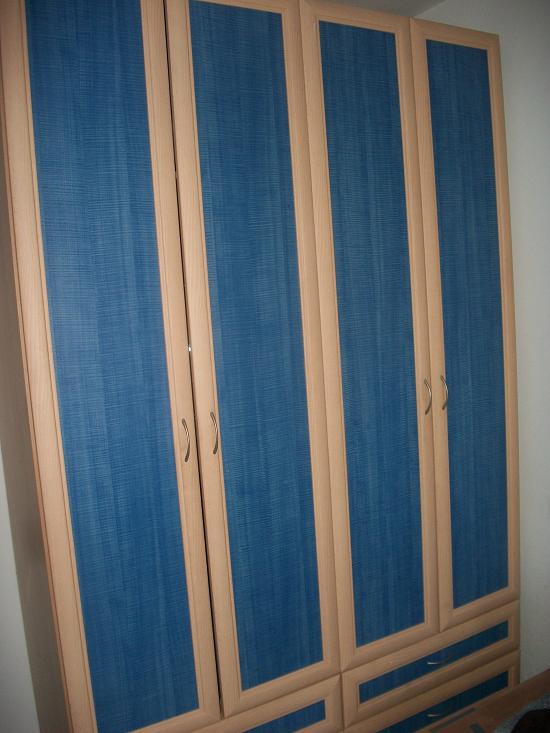
This is the four door closet for the girls’ room. The previous tenants had originally offered to sell this to us for 1000 shekels; I offered 500, which I felt was reasonable based on my yad2 browsing. They ended up leaving it behind after taking it apart and realizing it was too much work to get it down the spiral staircase from the upper bedroom. They told us they were leaving this (and some other items upstairs that were equally cumbersome to get downstairs) in exchange for the paint they should have paid for. It’s not exactly free but I think of it as if it was.
The next bedroom is our guest room that dd16 likes to call her room. I’m holding out on calling it hers as a matter of principle. 🙂
Four door clothing closet with four drawers at bottom
This next bed took a while to find, since I was trying to find something that matched the wood of the closet we had already purchased. (It’s not easy trying to match furniture just by the online pictures in the ads, since lighting affects the accuracy of the picture!) It’s easier to first buy the bed and then match the closet to it, but we bought what we did in the order that we found things.
This has an additional pullout bed, and two huge storage drawers (width and depth of bed) that also pull out. The bed is 80 cm wide. We bought this in Moran for 700 shekels, and paid 100 shekels for delivery.
Same bed with additional bed pulled out
On to the boys’ bedrooms.
Littles’ bunk bed
This is one of the things we bought at the second hand store on a second trip. The price and quality were actually decent, but it doesn’t look as good as what I usually look for (you can see the stickers on it which the littles actually were excited about!). It’s all wood, and is 70 cm wide – there are three standard twin sizes in Israel (70, 80, 90), and 70 is called a youth size bed. If you measure a standard American twin, you’ll begin to see how buying Israeli furniture allows you to use the space much better. If we had US twin mattresses, we’d lose a lot of the floor space in between the beds and the closets, and the rooms would be much more crowded.
This was 700 shekels.
With additional bed for ds2 pulled out below
Below this bed is a pull out storage drawer (narrower than the beds), and I had the seller throw in an extra mattress. I was ideally looking for a bunk bed that had a pullout bed and storage box included, but this is what I found, so I improvised. The storage box is only 60 cm wide, but I cut down the foam mattress mattress to size, then resewed the mattress cover all around so it fits perfectly now. I plan to replace this with a pullout that is 70 cm and to use the drawer for storage, since due to the narrowness I consider it a short term solution for ds2. The delivery was supposed to be included, but the store owner called me when they were on the way and said he had made a mistake in calculating the prices, so he told me to pay the delivery guys 100 shekels when they got there, and he would also pay them 100 shekels.
Five door closet for boys
Across from the bunk beds is a five door closet that all of the boys share. I measured the space in each bedroom and got the largest closet I could in order to maximize storage space. The boys’ bedrooms are upstairs and due to the slant of the ceiling that starts at about 5’8″ high on one side of the room, this is the only space in the two rooms where we could put a full size clothing closet without blocking windows. Our ceilings are high and you can see it goes almost to the top, so there’s loads of space.
We bought this from someone in Haifa, and paid 600 shekels. Combined delivery with the fridge we bought the same evening was 550 shekels – the price was higher than usual because the closet had to be dismantled, and a refrigerator is a more expensive item to move.
Now the older boys’ room, shared by ds9 and ds12.
Second boy’s bed (note additional bed peeking out at left corner)
This is a bed I bought at the same time as the bunk bed, because the wood colors matched perfectly and I got it for a reasonable price.
This bed has an additional bed that pulls out from underneath, and the drawer from the bunk bed actually goes to this bed, which is where it will be returned to when I replace the pullout bed of the bunk. I’m considering cutting the legs on this pullout bed down so it will fit under the bunk. It was a little rickety when we got it but dh strengthened it with a few well placed braces and now it’s very sturdy. 300 shekels.
Boy’s bed with three storage drawers and additional pullout bed (not shown)
Across from the above bed is this one. This has three pullout storage drawers that are the width and depth of the bed, and an additional pullout bed. I didn’t bother taking a picture of that since you can probably figure out how it works by now! The pullout of this bed is what ds18 will use when he comes home.
I bought this in Haifa, and paid 500 shekels for the bed (he was asking 600), and 300 for delivery (delivery also included a stop at Kiryat Motzkin, to pick up most of dd16’s belongings that she had left there over the summer). This bed also took some effort to find since I was trying for a close match of the first bed, which was difficult since the newer beds are a different shade. It’s not perfect but it’s quite close and the room looks nice.
There’s also a small two door cabinet with two shelves and two drawers that was also left behind by the previous tenant that is a perfect match to the above bed that’s in this room. This allows the older two boys to keep a nice amount of their things in their room, though the closet is really just a few steps away.
Now back downstairs to the salon (living room/dining room).
Dining room set with eight chairs
Finding a suitable dining room set wasn’t easy. Most sets have just 6 chairs, so I was trying to match up different dining room sets from totally different areas, just by looking at the pictures online, so that we’d have twelve chairs. I was trying to keep in my mind over two hundred sets and went back and forth between sets, looking at the wood shades, counting the wood backing strips of the chairs to get a close match…I was getting a big headache from this. Since the sets were sold with tables and chairs, I would end up with two tables, and I planned to put one table in the kitchen, though I didn’t really want more than one table, total.
Finally, I decided to just look for one with eight chairs, and to supplement with folding or stacking chairs as needed. There weren’t many sets available that had eight chairs, and when combined with the size table I was looking for and the price range I wanted to stay in, it took some looking. I was pleased when I came across this set, which is solid wood and very well made.
We bought this in Kfar Tavor, and it was 2000 shekels. We paid 200 shekels for delivery of this, which included delivery of the oven the same evening. I was pleasantly surprised when dh got home to see how heavy the table and chairs were. There are two leaves of half a meter each that are added to each end (not pictured), which brings the table to a total length of 2.9 meters, large enough to comfortably seat 12. We can manage to fit around here for regular dinners without putting the leaves in, by seating two people at each end.
Couch on left
We bought our couches from the second hand store on our first trip there. Ds18 was with us and thought they looked decent, and since at that time we had no furniture, I expected the other kids to be excited when the couches arrived since we’d finally have a place to sit and relax. They hated them! Dd16 even told me they’re so ugly that she’ll be embarrassed to bring her friends over; I won’t share the more graphic comments about how ugly they were. It’s more of a European style (which makes sense, since they were made in Italy), but they prefer American style couches. They aren’t perfect, but I think they’re nice. And the kids have gotten used to them by now. (Sorry the picture isn’t so good; I took it for an intended post to show you the set up of the apartment.)
It’s a set of three couches, medium brown leather with solid wood frames. In the picture you can see the big couch on the left; in the foreground is the edge of the matching chair, and across from that is a loveseat. The way this second hand place is, things are stacked on top of one another and you can’t fully see what you’re getting, unless you insist that the owner take out every single item, which isn’t such a small thing to ask. I asked him to take down the loveseat for me, and sat on it to see how comfortable it was; it looked good. The two larger couches were in fine condition, but the matching chair looks significantly more used, which I didn’t realize until they arrived. They were 900 shekels.
On to the kitchen. I already wrote about the challenges of our fridge and stove, but these problems actually were the catalyst for a much better working solution for our appliances. So I’m really glad that we didn’t have things that worked okay to start with, since we would have settled for them and it would have continually crimped my ability to function effectively in the kitchen.
After trying to use the standard size Israeli stove that was left behind (which only had one rack that was kashered), I realized that part of the problem we were having, is that we cook such large quantities that we simply needed something bigger. I had planned initially to keep this stove and make do, but this realization got me thinking in a different direction.
I was up late one evening when I saw this oven come up for sale, and though I hadn’t specifically been looking for something like this, as soon as I saw it I knew that’s what would be perfect for our needs. But I didn’t know if it would still be available by the time I was able to call about it in the morning.
This is the space intended for the fridge and the oven
I’ve rarely seen ovens this large for sale second hand, probably because Israeli kitchens aren’t sized to allow for something this large; it is 90 cm wide. But when looking at the space in my kitchen, I realized I could put the oven where the fridge and oven were supposed to be, and then put the fridge across from that where the table would be (if we had one).
I was delighted when I learned it was available, then less delighted when I learned that although he advertised it being in Karmiel, it was actually located in a different town. (This was only the second item I was buying directly from a seller, and I wasn’t yet comfortable with the idea of paying someone to travel there to get it, regardless of if I’d end up getting it or not. I got used to buying something based on skimpy pictures followed by a phone conversation with the seller, rather than seeing it in person, pretty quickly.) After speaking to him, I decided to send dh together with the delivery guy to go buy it. Dd15 and dd16 had been very frustrated when trying to cook for Shabbos, and I didn’t mention to them that we were getting this, since I wanted to surprise them when it arrived. They love it and so do I! Cooking for our family got so much simpler with this purchase, and though it was more money than I could have gotten a perfectly good stove for, I feel it was a very, very worthwhile purchase and an effective use of our kitchen space.
And we did get an excellent price – we bought it from a seller in Rakefet for 1000 shekels. As I mentioned above, we paid 200 shekels delivery including the dining room set.
Finally, our fridge.
Our wonderful new fridge
I’ll detail in another post how I decided on this model, but this has a good capacity (I think 568 liters, but I might be wrong on that) and I liked the setup of it. The seller was asking 1900 shekels, and said he was slightly flexible on the price, so we paid 1800. I know, not exactly major savings. 🙂 This is lots more than I initially planned to pay for a fridge (my original budget was 1000 shekels), but after our first fridge fiasco that ended up costing us 1400 shekels, I decided to get something newer that would hopefully last us for a long time. The delivery cost was listed above, 550 shekels for this and the five door closet.
If you’re wondering what we’re doing with the old fridge, I found a solution!
An expensive ‘lemon’, but a decent cooler
The fridge itself actually looks nice (unlike the first one, which was not a bit attractive), but the fridge part is like a cooler and the freezer part is like a fridge. I decided to keep it to store the fresh fruits and vegetables in, which I buy in such large quantity each week that I really don’t have room in one fridge. Before this I couldn’t buy enough in one trip to last for a week. This also works well since it’s not opened as often as a regular fridge, so it keep the cold better than it did when we needed to open it often. It’s next to the good fridge, in the kitchen, in the space that would have accomodated a kitchen table.
I didn’t take a picture of our washing machine, which I think is the only thing left. We paid 900 shekels at the used furniture place, which was too much and I knew that when I bought it, but I needed something and I hadn’t yet figured out a way to buy directly from sellers. Thank G-d it works and as long as it continues to work, it will be fine. At the point in the (I hope, distant) future that I need to replace it, I’ll look for a ten kg model. This is supposedly a 7 kg model, but I say supposedly because that’s what I wanted so that’s what the seller said it was. I can’t find it written anywhere to say how much it actually holds, and since the veracity of his words has been repeatedly been shown to be questionable, I’m not assuming in this case he actually said the truth.
We still need to buy beds for dh and I, a clothing closet for our room, and eventually will need some bookshelves when the twelve boxes of books we’re sending on someone’s lift will arrive. You might be getting caught up in how much more cheaply all of these things could be purchased in the US, and you’d be right. But when you take into account how much it would cost to ship the items here, it changes the picture quite a lot.
These were all good buys, but if just getting basic furniture was my goal, I could have spent much less. For example, someone offered us a free, wobbly table, and someone else offered us a fridge that doesn’t seal well. That could have been fine. However, this was my chance to furnish our home, and I was willing to spend more to get what I wanted and felt good about, while staying in my budget. If I would have gotten things given to me, or bought very cheaply, the total spent would have been less but my home would be mismatched; I would have ended up keeping it because it basically worked even if it didn’t look great.
I’m a visual person and seeing nice looking things around me makes me happy, and seeing things that look junky doesn’t bring a smile to my face. It doesn’t have to be fancy, but I want what I buy to be good quality and stand up to the heavy usage it gets in our home. To me, bring frugal doesn’t mean that you do without things that are important to you because you must get everything for the least possible amount of money, but about having the quality of life you want within the financial constraints of your budget.
Even so, you can see that the total (if you’re doing the math), though not small, even including the extra delivery costs, is still far less than the approximately $6000 to send a 20 foot lift, or $10,000 (36,000 shekels) to send a 40 foot lift (which is the size that would be big enough to have brought all the things we needed to buy). (And I would have had to buy furniture to bring with us on a lift, so we had to take that into account, as well!)
We’re really happy to have bought the furniture we did here; not only was it a more affordable option, but equally important, it uses the space well and the apartment feels nice and spacious!